
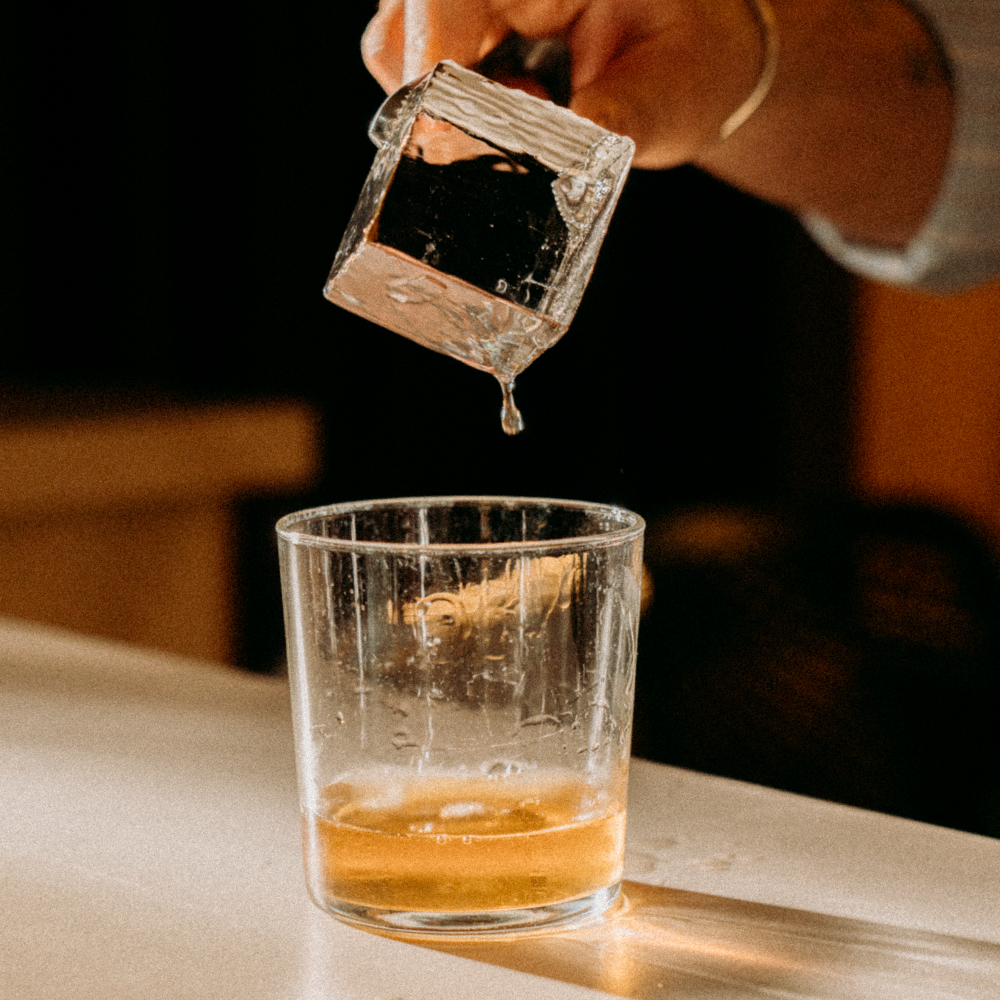
You’ve got your premium Crystal Muse clear ice in hand. You place it in the glass, pour your cocktail over it, and — crack. The ice splits, sometimes dramatically. It’s frustrating, especially when you’ve invested in quality ice specifically to create a beautiful presentation.
Here’s the good news: clear ice cracking is almost always preventable, and the solution is simple once you understand what’s causing it.
The Main Cause: Thermal Shock
The overwhelming cause of clear ice cracking is thermal shock — a rapid, extreme temperature change that creates stress within the ice faster than it can accommodate.
Ice from your freezer is typically stored at around -15°C to -18°C. When you pour room-temperature or warm liquid over frozen ice, the outer surface rapidly warms and expands while the interior is still extremely cold and contracted. The difference in expansion rates creates internal stress — and when that stress exceeds the ice’s tensile strength, it cracks.
The denser structure of clear ice, while an advantage in most ways, also means thermal shock produces more dramatic cracks than in cloudy ice (which absorbs some of the stress through its porous, bubble-filled structure).
The Solution: Tempering
Tempering is the process of allowing ice to warm slightly before use, bringing its surface temperature up enough to minimize the thermal differential when liquid is added. It’s exactly the same principle used in metallurgy and glassmaking. You’re reducing the temperature gradient to a manageable level.
How to Temper Clear Ice
- Remove your clear ice from the freezer 2-3 minutes before use.
- Let it sit at room temperature on a clean surface or in the empty glass.
- You’ll see the surface begin to appear slightly wet and glossy — this is the outermost layer softening. Once tempered, place the ice in the glass and proceed with your drink.
💡 Professional bartenders often temper ice by briefly holding it under a slow stream of cold (not warm) water. This perfect tempering happens in about 10 seconds.
1. The Physics of Coefficient Expansion in Pure Ice
To truly understand clear ice cracking, we must look at the coefficient of linear expansion. Because clear ice is a pure crystalline structure without air pockets, it behaves more like glass than standard ice. When the exterior expands due to the heat of the spirit, the “rigid” interior cannot flex. Tempering allows the ice to enter a more “plastic” state on the surface, which can absorb the kinetic energy of the liquid without snapping the crystalline bonds.
2. Nucleation and Surface Tension Stress
When you pour liquid over untempered ice, the immediate “sizzle” you hear is the result of extreme surface tension. This tension pulls the ice in different directions simultaneously. By tempering, you are allowing a micro-layer of liquid water to form on the surface. This water acts as a thermal buffer and a lubricant, distributing the heat of the incoming spirit more evenly across the face of the cube or sphere, preventing localized stress fractures.
3. Storage Temperature vs. Serving Success
If your home freezer is set to “Deep Freeze” (below -20°C), the risk of clear ice cracking increases exponentially. The colder the ice, the more brittle the crystalline lattice becomes. If you know your freezer is exceptionally cold, extend your tempering time to 5 minutes. Professional bars often keep their service ice in slightly warmer wells to ensure it is always “ready” for the pour without the risk of shattering.
Troubleshooting Guide: Ice Performance by Condition
| Condition | Risk of Cracking | Suggested Tempering | Best Pouring Speed |
|---|---|---|---|
| Deep Frozen (-20°C) | Very High | 5+ Minutes | Ultra-Slow |
| Standard Freezer (-15°C) | High | 2–3 Minutes | Slow & Steady |
| Warm Spirit (>22°C) | Moderate | 4 Minutes | Gentle Stream |
| Chilled Spirit (<5°C) | Low | 1 Minute | Normal |
Other Causes of Cracking — and How to Fix Them
– Pouring Too Fast: Even with tempered ice, a fast pour creates a localized pressure point. Pour slowly, aiming at the center of the ice, not the glass wall.
-Using Very Warm Spirits: Most spirits are at room temperature (20-22°C). If your bottle was in a warm environment, let it cool slightly first.
-Putting Ice in a Warm Glass: A glass fresh from the dishwasher will accelerate thermal shock. Chill your glass in the freezer for a few minutes first.
-Spheres Are More Sensitive: Due to their curved surface, ice spheres have a more pronounced thermal gradient. They require careful tempering and very slow, gentle pouring.
When You Hear a Crack — What to Do
If your ice does crack despite your best efforts, don’t panic. A single crack in a clear ice cube or sphere doesn’t ruin the drink. The ice will still chill properly and melt at a reasonable rate. It just won’t look as pristine.
For presentation purposes, if an ice piece cracks significantly before you’ve poured the drink, simply set it aside and use a fresh piece (after better tempering).
The Simple Rule
Temper every time. 2-3 minutes at room temperature before use eliminates clear ice cracking in virtually all situations. It’s the one habit that makes the biggest difference in using clear ice correctly — and it takes almost no effort once you make it part of your drink-making routine.